
OlyLife P90 Magnetic Field Test vs PEMF Mat: What I Measured
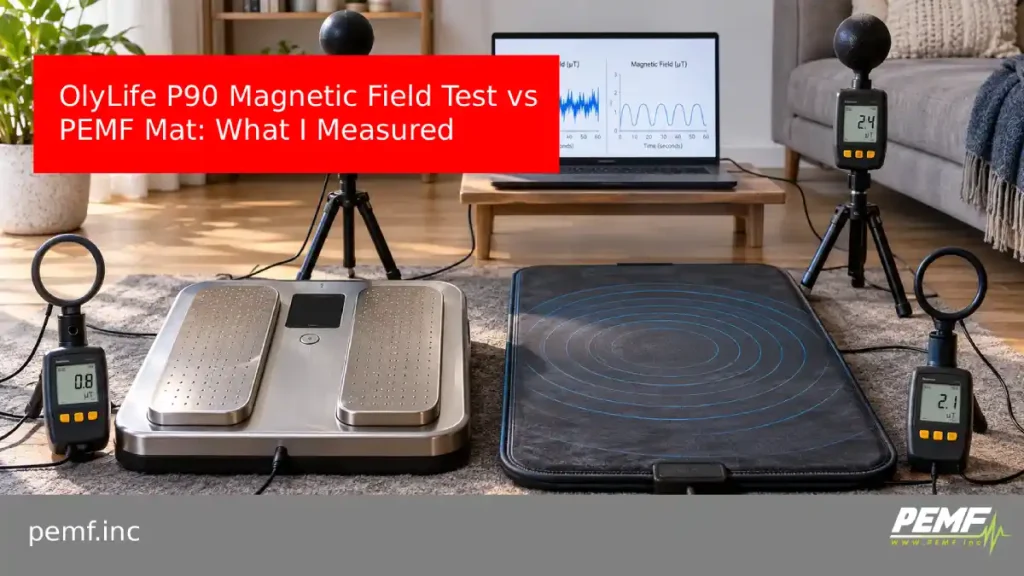
There has been considerable discussion online about the OlyLife P90 and whether its technology should be described as PEMF.
Rather than relying solely on product descriptions or marketing terminology, I purchased an OlyLife P90 and carried out my own measurements.
I wanted to investigate two simple questions:
Can I measure a pulsing magnetic field from the OlyLife P90?
And:
What happens when I compare those measurements with a conventional coil-based PEMF applicator?
The results showed a very clear difference between the two devices.
For a more detailed examination of the device, including what is inside it and my other testing, visit my full OlyLife P90 Review and Independent Testing.
What Is PEMF?
PEMF stands for Pulsed Electromagnetic Field.
A conventional PEMF system uses an electrical signal to drive a coil or another specifically designed electromagnetic applicator. The changing electrical current produces a changing magnetic field.
Importantly, the person does not normally need to become part of an electrical circuit or make bare-skin electrical contact with an electrode for the magnetic field to reach the body.
That distinction became particularly interesting when I tested the OlyLife P90.
How the OlyLife P90 Is Used
The OlyLife P90 has two metal footplates.
The user places their bare feet directly onto these plates during operation.
This is very different from the PEMF mats and applicators I have worked with over many years, where the magnetic field can be measured above the applicator without the body needing to make electrical contact with its surface.
I therefore decided to test both magnetic-field activity and electric-field activity.
Testing the OlyLife P90 for a Magnetic Field
I used a field meter to measure the area around and above the OlyLife P90 while it was operating.
I also tested it with my feet positioned on the metal plates.
In my testing, I did not detect a pulsing magnetic field comparable to the field produced by the coil-based PEMF applicator used for comparison.
Putting my feet onto the OlyLife plates did not produce the type of measurable magnetic-field response that I see when testing a conventional PEMF applicator.
This is an important observation because if a device is being discussed as PEMF technology, one of the most basic questions I believe consumers should ask is:
Where is the pulsed magnetic field, and can it be measured?
Then I Tested the Electric Field
The results were very different when I changed the meter to measure electric-field activity.
With contact with the OlyLife P90’s metal plates, I observed a substantial electric-field response associated with the body.
When contact was removed, the measurement changed significantly.
This suggests that electrical coupling/contact with the footplates is an important part of what the meter is detecting.
I would describe this carefully as electrical-field/contact activity, rather than claiming that my meter establishes the precise electrical current flowing through the body. Measuring an electric field and directly measuring electrical current through the body are not the same test.
That distinction is important.
OlyLife P90 vs PEMF Applicator
I then performed the same type of testing using a conventional coil-based PEMF applicator.
The result was essentially the opposite.
With the PEMF applicator operating, I could clearly detect the pulsing magnetic field above the applicator.
I could continue moving the meter away from the applicator and still detect the magnetic pulses at a distance.
When positioned around the feet and lower legs, the magnetic-field activity could be measured well beyond the surface of the applicator.
Most importantly, direct electrical contact with the applicator was not required.
The magnetic field exists in the space above the applicator.
Magnetic Field vs Electric Field — They Are Not the Same Measurement
This is where terminology becomes extremely important.
An electric field and a magnetic field are related aspects of electromagnetism, but measuring one does not automatically mean that you have demonstrated the other in the form relevant to a PEMF device.
A device producing an electrical-field response through contact with metal plates should not automatically be assumed to be producing the same type of pulsed magnetic field as a coil-based PEMF system.
This is precisely why I believe measurements are useful.
Rather than debating terminology, we can test what is physically present.
For additional photographs, information about the P90’s internal construction and my broader analysis of the technology, see my complete OlyLife P90 review.
What My OlyLife P90 Testing Showed
In my tests:
- The OlyLife P90 produced a strong electric-field response associated with contact with its metal footplates.
- I did not measure a comparable pulsing magnetic field above the P90 using my test setup.
- The coil-based PEMF applicator produced an easily measurable pulsing magnetic field.
- The PEMF magnetic field could be measured away from the surface of the applicator.
- The PEMF applicator did not require bare-skin electrical contact for its magnetic field to be measured.
These are measurements from my particular testing setup and should not be interpreted as laboratory certification or as proof of what every OlyLife model produces under every possible measurement method.
They do, however, demonstrate a very noticeable difference between the two technologies I tested.
Does This Mean the OlyLife P90 Does Nothing?
No. That is not what this test establishes.
My test was designed to investigate what type of field I could measure, not whether someone experiences a sensation or whether the device has other effects.
Electrical stimulation and electromagnetic-field exposure are not interchangeable concepts.
A person can experience electrical stimulation without that establishing that a device is producing the type of pulsed magnetic field generated by a conventional PEMF coil.
The question I am investigating is much narrower:
When the OlyLife P90 is described in connection with PEMF, can I actually measure a pulsed magnetic field comparable to a conventional PEMF applicator?
In my testing, I could not.
Why This Matters When Researching PEMF Products
Consumers searching for PEMF machines encounter many different technologies using terms such as:
PEMF, frequency therapy, terahertz, bioelectricity, electrotherapy, scalar energy and electromagnetic therapy.
These terms should not automatically be treated as meaning the same thing.
If a manufacturer or distributor cites PEMF research, I believe another important question should be asked:
Was that research performed using technology comparable to the product being marketed?
Research performed using coil-generated pulsed magnetic fields does not automatically validate a different technology simply because both are described using words associated with frequencies or electromagnetism.
Questions I Recommend Asking Before Buying a PEMF Device
When investigating any device marketed as PEMF, ask:
Where is the magnetic field generated?
What produces the magnetic field?
Can the pulsed magnetic field be measured above the applicator?
What is the waveform?
What is the frequency range?
What is the magnetic-field intensity?
Does the body need to make electrical contact with electrodes or metal plates?
Does the scientific research being cited actually use comparable technology?
These questions can reveal much more than marketing terminology alone.
My Conclusion
My comparison showed two distinctly different measurement patterns.
With the OlyLife P90, the prominent measurement in my testing was electrical-field activity associated with contact with the metal footplates. I did not detect a comparable pulsing magnetic field above the device.
With the coil-based PEMF applicator, I could clearly measure a pulsing magnetic field extending away from the applicator without requiring electrical contact with the body.
That doesn’t require anyone to simply accept my opinion.
The purpose of doing these demonstrations is to show the measurements so people can see the differences and make their own informed assessment.
Watch My OlyLife P90 Testing and Read the Full Review
My testing includes magnetic-field and electric-field measurements of the OlyLife P90 and comparison testing with a conventional coil-based PEMF applicator.
For the complete investigation, photographs, device information, testing and ongoing updates, visit:
Learn More About PEMF
For further independent testing, PEMF education and comparisons of PEMF technologies, visit:
Alternatively, you may contact us for further information or enquiries.
Australia: 0414 644 120
International: +61 414 644 120