
Is the OlyLife P90 Really PEMF? Understanding Electrical Contact vs Pulsed Magnetic Fields
The OlyLife P90 is frequently discussed using terminology associated with PEMF, frequencies and electromagnetic technology.
But an important question is often overlooked:
What type of energy can actually be measured from the device?
After purchasing an OlyLife P90, I decided to investigate this myself and compare it with the German-made coil-based PEMF equipment I have worked with for many years.
Rather than concentrating on marketing terminology, I wanted to examine something much more straightforward — what could I actually measure around each device?
The comparison produced two very different measurement patterns.
For photographs, additional testing and a more detailed examination of the P90, visit my complete OlyLife P90 Review – Independent Testing & Comparison.
Why the Difference Between Electricity and a Pulsed Magnetic Field Matters
Electricity and magnetism are closely related, but they should not simply be treated as interchangeable measurements.
PEMF stands for Pulsed Electromagnetic Field.
In a conventional coil-based PEMF system, an electrical signal passes through specially designed coils. This produces a changing magnetic field that extends into the space surrounding the applicator.
This means the body does not need to make direct electrical contact with the coil for the magnetic field to reach it.
That is one of the important differences I observed when comparing our German-made PEMF equipment with the OlyLife P90.
The OlyLife P90 Uses Metal Footplates
The P90 is operated by placing the user’s bare feet directly onto two metal plates.
This immediately makes it physically different from a conventional PEMF mat or pad.
I therefore wanted to determine what my meters would detect both at the plates and above the device.
I tested for magnetic-field activity and separately investigated electric-field activity.
What Did I Measure Above the OlyLife P90?
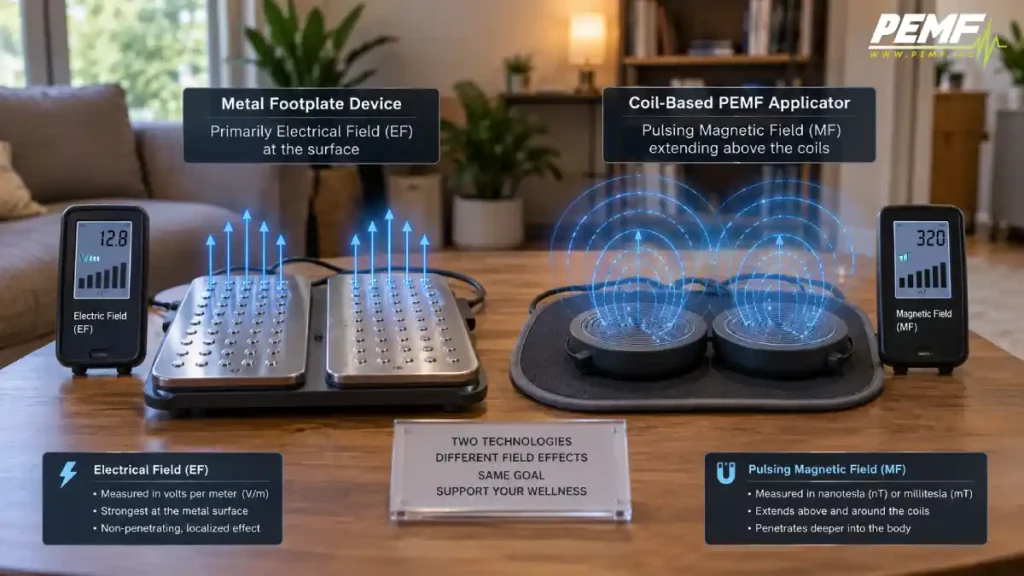
When testing the OlyLife P90, I did not find the type of measurable pulsing magnetic field above the footplates that I observed with our coil-based PEMF applicator.
I also tested the P90 with my feet placed on the plates.
In my test setup, putting my feet onto the P90 did not result in a comparable pulsing magnetic field being measured above the device.
That raised an obvious question:
If the prominent effect isn’t a measurable pulsing magnetic field like the one coming from the PEMF coils, what is the meter detecting?
Testing the Electrical Field Told a Different Story
When I tested for electric-field activity, the result was noticeably different.
With contact with the P90’s metal footplates, I detected substantial electrical-field activity associated with the body.
The measurement changed when contact with the plates was removed.
Therefore, in my testing, electrical contact/coupling with the metal footplates produced the prominent electrical-field measurement, while I did not detect a comparable pulsing magnetic field extending from the footplates.
It is important to distinguish an electric-field measurement from directly measuring the amount of electrical current flowing through a person’s body. My test demonstrates what the meter detected; it should not be interpreted as a laboratory measurement of current through the body.
Then I Tested a German-Made PEMF Applicator
I performed comparison measurements with one of our German-made coil-based PEMF applicators.
The measurement pattern was quite different.
The applicator contains coils designed to generate a pulsing magnetic field.
When the PEMF system was operating, the magnetic-field meter clearly responded to the pulses.
The field could be detected above the applicator rather than only when touching it.
Moving the meter progressively farther away also demonstrated that the magnetic field extended into the surrounding space.
There was no requirement for my bare skin to make electrical contact with the applicator to detect the pulsing magnetic field.
What About Electrical-Field Activity From the PEMF Applicator?
This was another interesting part of my comparison.
When I tested our German-made PEMF applicator, I did not obtain the prominent electrical-field response associated with direct footplate contact that I observed during my P90 testing.
Instead, the prominent measurement from the PEMF applicator was exactly what I was looking for:
a pulsing magnetic field generated by the coils.
This provided a useful side-by-side demonstration.
With the P90, my prominent measurement involved electrical-field activity associated with contact with the metal footplates.
With the German-made PEMF applicator, my prominent measurement was a pulsing magnetic field extending above the coils without requiring direct electrical contact with the body.
Why Coils Are Important in Conventional PEMF Systems
A coil is one established way of converting an electrical signal into a changing magnetic field.
The signal generator controls characteristics such as frequency and waveform, while the applicator’s coils produce the magnetic field.
This is why a PEMF mat can be placed beneath the body and still produce a magnetic field without needing exposed metal electrodes against the skin.
The user does not have to complete an electrical contact path between bare skin and metal plates for the magnetic field to exist.
Can PEMF Energy Be Measured Away From the Applicator?
This is one of the simplest demonstrations I performed.
With the coil-based PEMF applicator, I could place the magnetic-field meter above the pad and observe the pulsing field.
As I increased the distance, the field became weaker, as expected, but remained measurable over a useful distance in my test.
This demonstrated that the magnetic field was extending away from the applicator into the surrounding space.
During my testing of the P90 footplates, I did not observe a comparable pulsing magnetic field extending upward from the device.
Feeling Energy Doesn't Identify the Technology
People may report sensations when using many different types of electrical or frequency-related devices.
But experiencing a sensation doesn’t by itself establish what physical field is being generated.
Electrical stimulation can create a noticeable sensation.
A PEMF system can produce a pulsed magnetic field without requiring the person to feel an electrical charge through their skin.
Therefore, personal sensation and measurement should not be confused.
If we want to understand how a device works, it makes sense to investigate what is physically measurable.
Is Electrical-Field Activity the Same as PEMF?
Not necessarily.
Electric and magnetic fields are related through electromagnetism, but detecting an electric field does not automatically establish that a device is producing the same pulsed magnetic field as a conventional coil-based PEMF system.
That distinction becomes particularly important when scientific PEMF studies are used to support a product.
The appropriate question isn’t simply:
“Does this device use frequencies?”
A better question is:
“Does this device generate the type of pulsed magnetic field used in the research being cited?”
Does My Testing Prove the OlyLife P90 Has No Effect?
No.
That isn’t the purpose of these tests.
I am not attempting to determine every possible biological effect of the OlyLife P90.
I am investigating a much more specific technical question:
How does the measurable field activity of the P90 compare with a conventional coil-based PEMF system?
My measurements demonstrated a clear difference.
What Consumers Should Look For When Comparing PEMF Machines
Before purchasing something marketed in connection with PEMF, frequencies or electromagnetic technology, I recommend finding out what the device actually produces.
Useful questions include: Where is the pulsed magnetic field generated? Does the applicator contain coils or another identifiable magnetic-field-generating system? Can the magnetic field be measured above the applicator? What frequency, waveform and magnetic-field intensity are specified? Does the device require bare-skin contact with metal electrodes? And was the scientific research being quoted actually conducted using comparable technology?
These questions help separate measurable technology from marketing terminology
Two Devices, Two Very Different Measurement Patterns
My comparison of the OlyLife P90 and our German-made coil-based PEMF equipment produced distinctly different observations.
OlyLife P90: In my testing, I observed substantial electrical-field activity associated with contact with the metal footplates, while I did not detect a comparable pulsing magnetic field extending above the footplates.
German-made coil-based PEMF applicator: I measured a clear pulsing magnetic field generated from the applicator and extending into the surrounding space without requiring direct electrical contact between the applicator and the body.
This is why I believe independent measurements are valuable.
Rather than asking consumers to accept either marketing claims or my opinion, I prefer to demonstrate the measurements and allow people to examine the differences for themselves.
Read My Complete OlyLife P90 Review and Testing
I have documented additional OlyLife P90 testing, photographs and information about the device on my dedicated review page.
Visit:
Learn More About PEMF
For information about PEMF technology, German-made PEMF systems, independent testing and comparisons, visit:
Alternatively, you may contact us for further information or enquiries.
Australia: 0414 644 120
International: +61 414 644 120